| Duration | THREE DAYS |
|---|---|
| Location | YOUR FACILITY OR ONLINE |
| Course No | 2015 |
Course Summary
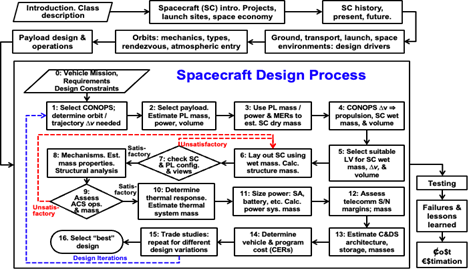
This is the most comprehensive short course on spacecraft design available. Attendees are exposed to an extensive and coherent treatment of the fundamental principles involved with the interdisciplinary design of spacecraft. Besides the engineering associated with the design of the spacecraft itself, the course also covers history and current spacecraft, details on the launch and orbital environments, the principles of orbital mechanics, and types and operations of onboard payloads. It also includes descriptions of all types of spacecraft testing, failures, reliability, and lessons learned, and the economics of spacecraft. The course provides many illustrative examples along with more than 60 short videos and animated diagrams as well as hardware “show-and-tell” samples and models to demonstrate important concepts. The flow of the course is shown below:
Testimonials:
“I again wanted to say that I really enjoyed your class and recommended to my management that all of our new hires should take such a class. It is certainly very useful to see your own area in the context of the entire space picture.” C.S., Senior Engineering Specialist, Aerospace Corp.
“Excellent course for people like me who wish to go into program management.” M.R., Engineer, Boeing Houston
“This course was great. Instructor was able to simplify but not talk down to audience. He explained all terms likely not to be understood.” Anonymous.
“Thanks! This was a great course. I especially liked the launch vehicle section and some of the communication and CDHS stuff.” Anonymous.
“The course was both enjoyable and very thorough. Having the slides available for additional notes was very helpful. Great course!” Anonymous.
“Would recommend. As a non-technical person some content was beyond my job scope, but explained well and gives me a reference for later.” N.P., Contract Administrator, Boeing
"Great lectures. Interesting. Not boring at all. Great notes, references for further investigation and research." V.B., Engineer, Boeing
Course Materials
Each attendee receives a full-color hard copy of the instructor’s Spacecraft Design, Development, and Operation - Class Notes, or equivalent, a 356-page book with color images of the 1,900+ slides presented during the short course, plus a Certificate of Completion.
Who Should Attend
- Satellite & launch vehicle systems & subsystems engineers
- Space mission designers & operations managers
- Payload systems engineers & integrators
- Technical managers
- Space industry analysts
- Satellite operators
- Technologists projecting future space applications
- Educators and students
What You Will Learn
How to specify the design requirements of a spacecraft, based on mission operations and orbital mechanics dictated by the launch vehicle. Loads environment on spacecraft from transportation to launch to on-orbit. You’ll be introduced to orbital mechanics and understand the reasons different orbits are used to carry out missions. You’ll learn about payload selection and design and the differences between direct- and remote-sensing payloads. You will see how the payload’s properties are used to obtain a first estimate of the spacecraft’s dry mass, power consumption, and volume. The spacecraft’s CONOPS (concept of operations) is used along with an understanding of rocket propulsion to obtain the required propellant mass so that the “wet” or loaded spacecraft mass can be found. With this, the course looks in detail at the eight subsystems: mission design, structure, propulsion, power, thermal, attitude control, telecommunications, and command and data handling. Each is discussed in detail and the course shows how to estimate the mass, power, and volume requirements of each. You will be introduced to spacecraft stowed and deployed configurations and their structural designs. You’ll be introduced to the details of vibration, shock, acoustic and thermal loads during launch and on-orbit. You will learn about guidance and control systems and how they differ based on configurations and missions. You’ll be introduced to manufacturing techniques as well as testing, reliability, and cost estimating. Throughout the process, you will be provided key design recommendations and rules of thumb, “sanity checks” for calculations, and will learn why things are ‘done the way they are.’ At the completion of this course, you will have been introduced to the complete process of spacecraft design and operation and will be able to “speak space,” understand many technical papers and presentations, and communicate with others in the space industry.
Course Outline
- Introduction to spacecraft Uses & needs • Space economy.
- SC Technical Evolution: Past: historic spacecraft, early Earth orbiters, planetary explorers, Moon race, Space Shuttle era • Current spacecraft: Earth orbiting, observation, commercial, military • Future spacecraft • World launch sites.
- Spacecraft Design Drivers 1, Pre-launch & launch environment: Transportation loads • Ascent trajectories & significant event definitions.
- Spacecraft Design Drivers 2, Space environment & how it affects spacecraft: Gravitational perturbations, station-keeping • Gravity gradient • Aerodynamic drag • Magnetic fields • Solar pressure • Space radiation: cosmic rays, solar flares, coronal mass ejections • Single-event upsets (SEUs) • Radiation shielding • Static buildup & discharge • Atomic oxygen • Orbital debris • Outgassing • Internal disturbances.
- Orbits & orbital mechanics: orbit definitions & geometry • Required speeds • Types of orbits • Orbital elements • Transfer orbits • Special Earth orbits: polar, geostationary (GEO), sun-synchronous (SSO), Molniya, others • Orbital perturbations, station-keeping • Plane changes • Interplanetary missions, trajectory correction maneuvers (TCMs) • Targeting and the ‘B-plane’ • Gravity assists • Orbital maneuvering & rendezvous (RDV) • Orbit phasing • Low-thrust orbital maneuvers • Orbital decay • Entry deceleration & heating • Thermal protection systems (TPS).
- Spacecraft mission & payload development: spacecraft missions & types • Design-development-flight cycle • Payload types: direct- & remote-sensing • Camera-Telescope-Sensor basics & resolution • Can you read a license plate from space? • Active sensing instruments • Payload design & selection.
- Spacecraft design drivers: The eight spacecraft subsystems • Mission operations • Three major design drivers • Initial dry mass & power estimation from payload properties & mass-estimating relationships (MERs) • Added margins for mass & power growth • Volume considerations • Launch vehicle interface • Typical component densities for sizing.
- Propulsion systems: ∆v & the rocket equation • Mass ratio • Specific impulse (Isp) Solid vs. monopropellant & bipropellant liquid systems vs. electric propulsion • Propellant management in microgravity • Mass estimating relationships (MERs) • Propellant mass from maneuvering ∆v requirements • Volume estimation & tank sizing, MERs & mass estimation.
- Structures, mechanisms, structural analysis: The general arrangement Launch vs. flight configurations • Configuration Checklist • Structure types & materials • Deployment mechanisms, pointing & articulation • Gimbals & scan platforms • Restraints & launch locks • Separation systems: frangible fasteners, clamp bands • Design load factors • Structure design process • Quasistatic analysis • Vibration & dynamics • Acoustics • Random vibrations • The loads cycle • Coupled loads analysis (CLA) • Structure system MERs & mass estimation. Mass properties: coordinate systems, calculation of center of mass (CM) & moments of inertia.
- Spacecraft attitude sensing, dynamics and control: Survey of stabilization, sensing, & control schemes: three-axis, gravity-gradient, spinners, dual-spin • Attitude sensors • Pointing accuracy vs. navigation. Dynamics & Control: spinners vs. non-spinners • Stability of spinners • Rotation maneuvers • yo-yo despinner • 3-axis & “bang-bang” control • Minimum impulse bit • Control via thrusters, reaction/momentum wheels, control-moment gyros (CMGs), magnetic torquers • Saturation • Attitude control system basics.
- Thermal control: System requirements • Energy balance & temperature calculation • Passive thermal control: coatings & insulation • Thermal Analysis with radiation; view factors • Active control • Simplified whole-spacecraft analysis • Worst-case steady temperatures • Transient thermal analysis • Thermal system MERs & mass estimation.
- Environmental Control & Life Support Systems (ECLSS) for crewed spacecraft • Human requirements: atmosphere (oxygen concentration, temperature, humidity) • Water management & recovery • Waste management • Fire detection & suppression • Radiation protection • Other functions: exercise, EVA suits & tools, hygiene, sleep, clothing wash • Long-term missions.
- Power systems: Definitions • Energy sources: chemical batteries, fuel cells, solar cells/photovoltaic, nuclear materials & radioisotope thermal generators (RTGs) • Chemistry & performance of batteries and solar • Sizing & life estimation for solar arrays & batteries • Electrical power control system sizing & mass estimation • Power system operational modes • Cabling! • Power system MERs & mass estimation.
- Telecommunications: basics & definitions • the Link equation & path losses • Data link budget • Antennas & performance • Ground stations • Deep space network (DSN) • Signal-to-noise calculation • Dealing with weak signals • Phased-array antennas • Optical communications • Ranging & navigation via telecom system • System MERs & mass estimation.
- Command & Data Handling: Basics • Data types • Encoding & commutation • Telemetry (TM) • TM basics: transducers & measurements, data handling, multiplexing • Functions of computers • Onboard storage • Software • Fault protection & safing • System MERs & mass estimation.
- Testing: Need & philosophy for testing • Types of testing • Test sequences • Testing examples: mechanical, deployment, spin, vibration (sine & random), shock, acoustic, thermal-vacuum, radio frequency • Software testing • Subsequent activities.
- Failures: examples & lessons learned: Why spacecraft fail • Most common failures • Failure case studies including propulsion, structure, avionics/software systems • ‘Five mistakes to look for’ • Redundancy • Best practices to avoid failures.
- Financial analysis, project management, cost estimation: Design decision-making • Cost engineering • Cost-estimating relationships (CERs) • Inflation • Fallacy of “cost per pound” or “cost per kg” reasoning • Software cost • Propellant cost.
Instructor
DON EDBERG, PhD
Don Edberg, Ph.D. is an Associate Fellow of the American Institute of Aeronautics and Astronautics (AIAA) and former Boeing Technical Fellow. He has been teaching aerospace vehicle design since 2001 at California State Polytechnic University, Pomona (CPP) and also lectures at USC. He is co-author of the Design of Rockets and Space Launch Vehicles textbook published in 2022, whose 1st edition won the 2021 AIAA Summerfield Award for the best textbook published in the last five years. Student design teams under his advisement have placed 1st, 2nd, or 3rd over 20 times in AIAA student design competitions. He has received the California State University Wang Family Excellence in Teaching Award, the Engineers’ Council Distinguished Engineering Educator Achievement Award, the CPP Provost’s Excellence in Teaching and the College of Engineering’s Outstanding Teaching and Outstanding Advisor awards, and the Northrop Grumman Faculty Teaching award. He has presented short courses in launch vehicle design and spacecraft design to several NASA centers, US Air Force and Space Force, National U.S. Transportation Safety Board, Civil Aeronautics Authority (U.K.), Northrop Grumman, Boeing Satellite Systems, and several smaller aerospace businesses. He was a Technical Fellow at Boeing and McDonnell Douglas, where he authored or co-authored ten US patents and received the Silver Eagle award from McDonnell Douglas as Chief Engineer on the STABLE active microgravity vibration isolation system that successfully flew on STS-73 U.S. Microgravity Lab-2 Space Shuttle mission in 1995. He has also worked at Convair, AeroVironment (where he was the Chief Engineer on the electric-powered, back-packable FQM-151 “Pointer” drone in 1988), JPL, NASA Ames, NASA Marshall Space Flight Center, and US Air Force Research Laboratory. He received a B.A. in Applied Mechanics from the University of California, San Diego, and M.S. and Ph.D. in Aeronautical and Astronautical Sciences from Stanford. He was recognized Engineer of the Year by the AIAA Orange County, CA section and is an Eminent Engineer in Tau Beta Pi.